Research thesis
From capable robots to capable teams
ZENO-1 · COLLABORATIVE INTELLIGENCE

About me
I'm Zihao Li.
I build physical intelligence that helps robots work together, remember what matters, and keep going.
01 Founding Researcher of ZENO AI
02 Proposer and lead researcher of Zeno-1, ZENO AI's collaborative physical intelligence architecture — read the report ↗
03 PhD student of William Zhi at the PAIR Lab, University of Sydney
04 Master's graduate of the College of Control Science and Engineering, Zhejiang University
05 Graduate of the Interdisciplinary Innovation Platform, Chu Kochen Honors College, Zhejiang University
My research
A second robot changes what the first can do.
Put two capable robots on the same physical task and capability does not simply add. Timing, contact, and motion from one robot change what the other can do next. I study how embodied agents read those changes and keep the joint task moving—starting with the interaction between them.
RELATIONAL · PERSISTENT · RECOVERABLE
THE WORLD AS INTERFACE
The same 3B model runs on each robot at 30 Hz. No central conductor, no privileged partner state: motion, object response, and contact become the interface.
THE PAST STAYS IN THE STATE
A compact interaction memory lets one policy carry evidence across eight subtasks and more than ten minutes—without resets or policy switching.
IMAGINE BEFORE CONTACT
Before committing, predictive introspection asks what an action will make possible for a partner. It selects the action leading to better partner behavior in 87% of cases, versus 61% without lookahead.
Zeno-1 in practice
The same idea, tested against a hundred ordinary tasks.
Zeno-1 brings this research into everyday physical tasks. These clips show robots coordinating through motion, contact, and a shared workspace. Read the Zeno-1 report ↗
SHARED PASSAGE
One robot's path is the other's constraint, read live instead of scheduled around.
SHARED LOAD
Let go too early and the task restarts. The tension itself is the coordination signal.
ROLES, NOT ASSIGNMENTS
Neither robot is told to scoop or to hold. The role is inferred from what the other has already started.
SEQUENCE FROM STATE
The bag can't be sealed while a partner is still filling it — Zeno-1 waits on the world, not on a message.
Research in motion
A good action preserves good futures.
The studies highlighted here are entry points into a broader, ongoing research program. Across robot learning, memory, planning, and physical interaction, I ask how agents can make progress without closing off what they—or their partners—need next.
2026 · COUPLED ROBOT POLICIES
Sequential
Asymmetric Imitation
Two robots can each know how to carry a sheet and still fail together. Sequential Asymmetric Imitation turns single-robot demonstrations into policies that learn to wait, yield, and recover as a partner changes the task.
View project ↗2026 · LONG-HORIZON MEMORY
TRACE
A useful clue can disappear from view long before a task is done. TRACE preserves causal evidence and routes it back at the branch where it matters, so a long-horizon policy can continue instead of starting over.
View project ↗2026 · FORCE-AWARE TELEOPERATION
TriPilot-FF
When a person works through a robot, contact is information. TriPilot-FF gives hands and feet a shared interface for reach, resistance, and repositioning—so the operator can feel what the robot cannot say.
View project ↗Selected research
The question keeps widening.
From motion planning and human contact to memory and multi-robot interaction, these papers follow one question: how can a robot act without losing sight of what—or who—its next action affects? These are selected works; the full research history is on Scholar.
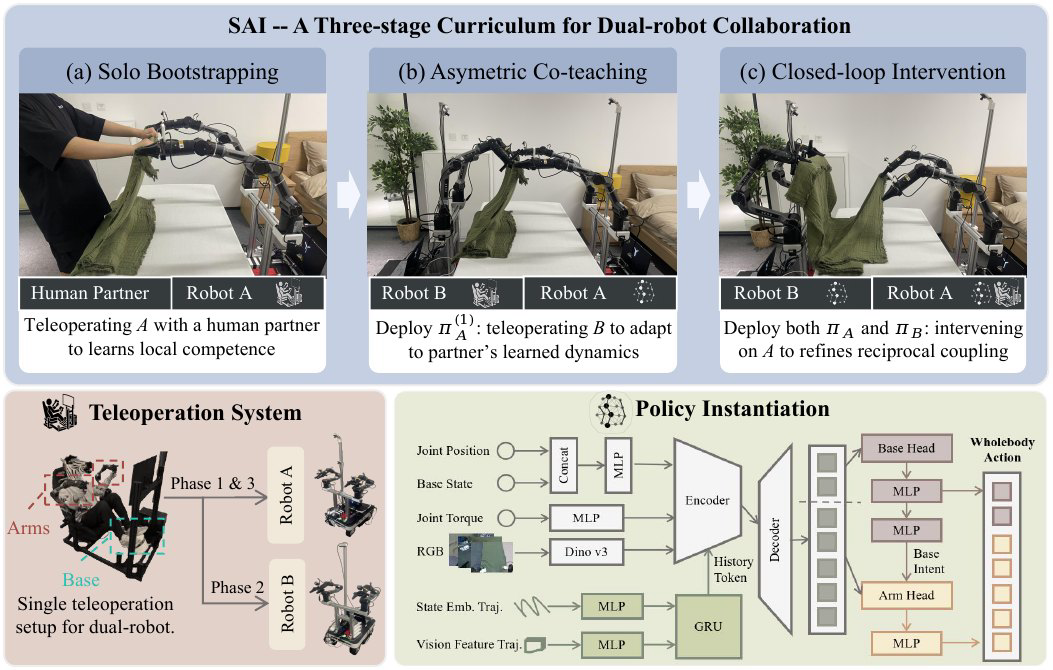
Robots that Collaborate: Sequential Asymmetric Imitation
Learning to wait, yield, and recover as a partner changes the task.
Read paper ↗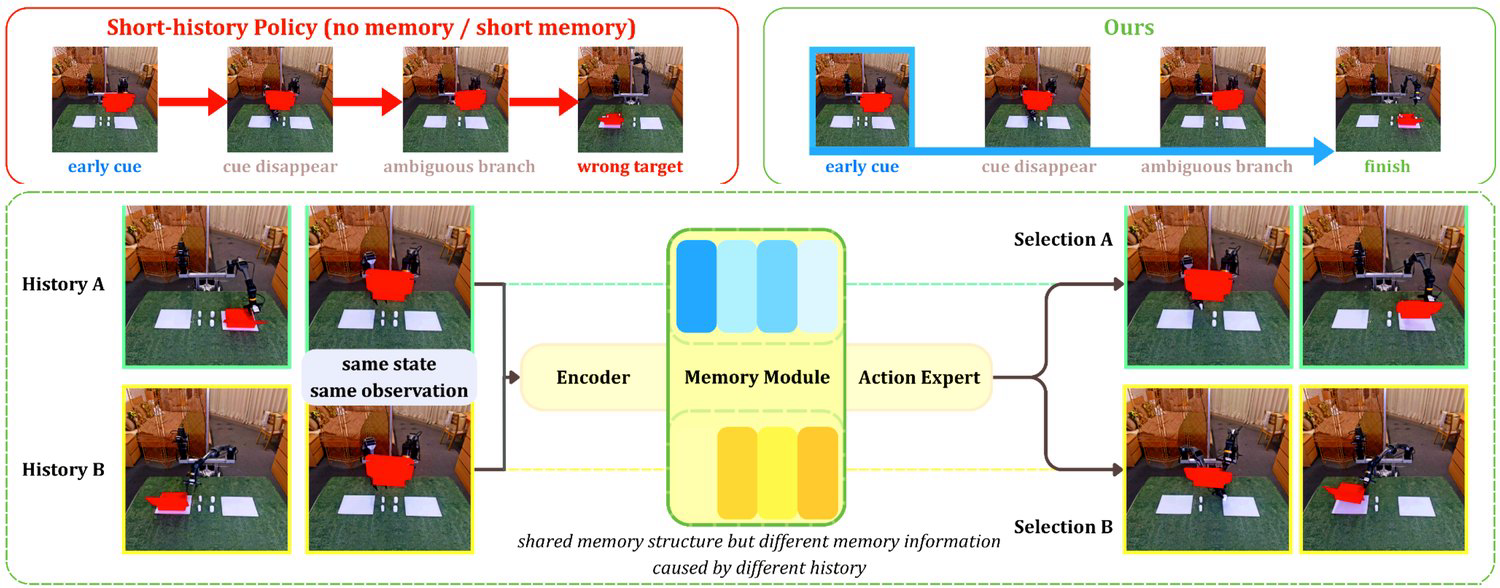
TRACE: Trajectory-Routed Causal Memory
Carrying evidence forward when the clue has already left the scene.
Read paper ↗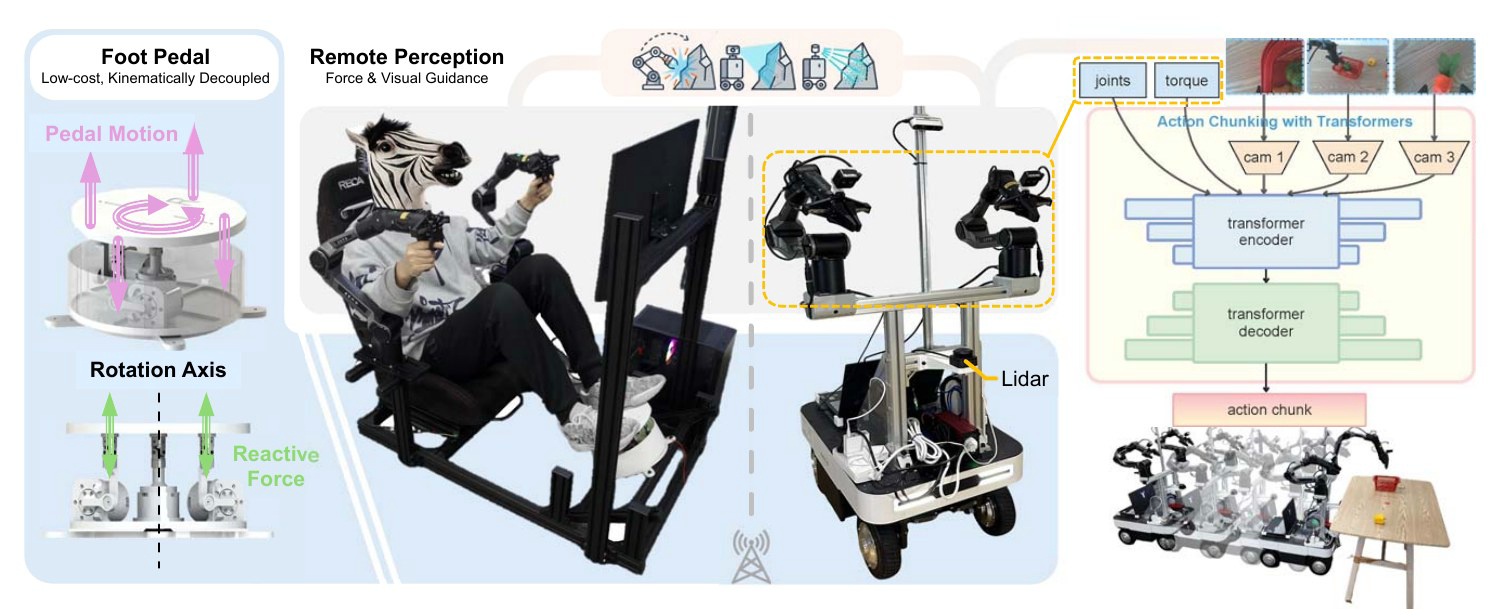
TriPilot-FF: Coordinated Whole-Body Teleoperation
Giving hands and feet a shared language for contact, reach, and motion.
Read paper ↗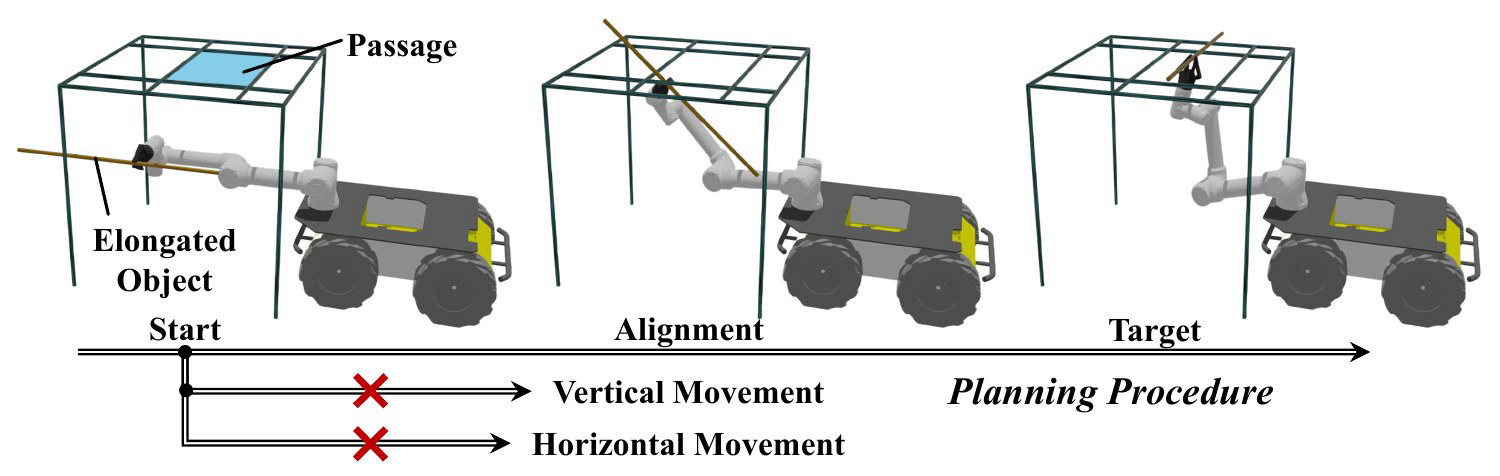
TAPOM: Task-Space Topology-Guided Planning
Finding the passage before searching the high-dimensional motion space.
Read paper ↗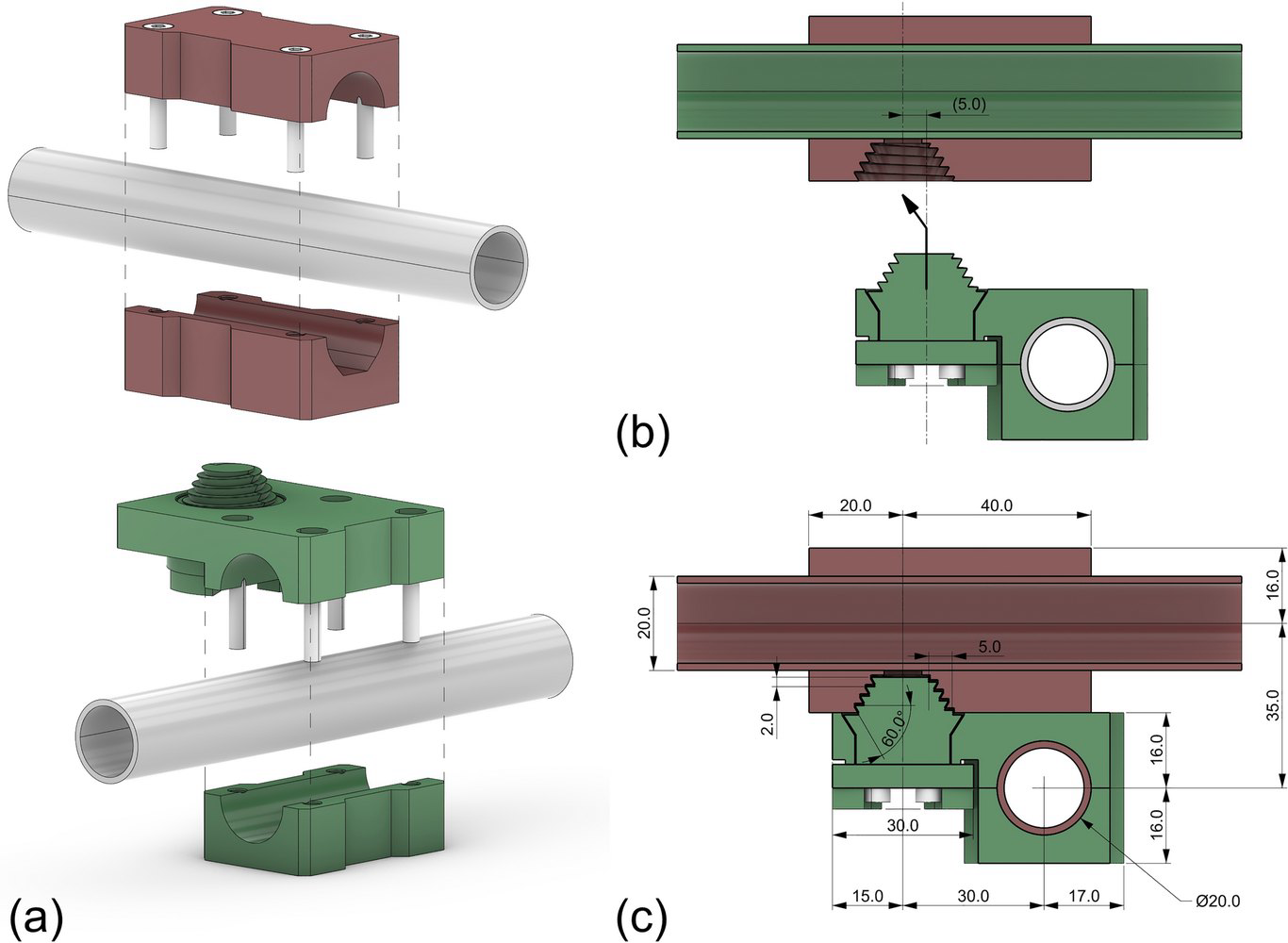
Robot-Friendly Scaffolding with Passive Error Correction
A tapered connector turns imperfect alignment into a reliable assembly step.
Read paper ↗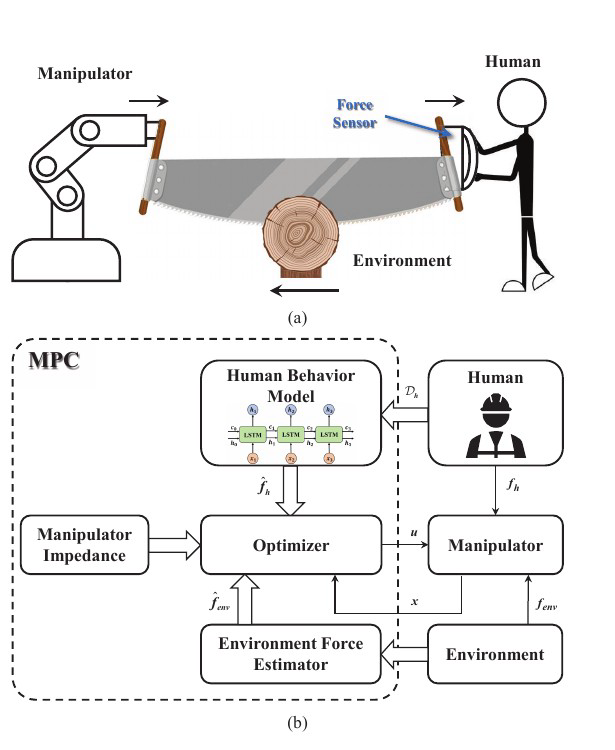
Operational Behaviors Inference for Physical HREI
Predicting human intent while optimizing motion around real contact.
Read paper ↗